Wolf Group — Deep Earth Seismology (text version)
Text version of this page for browsers and crawlers without JavaScript. The Wolf Group, led by Jonathan Wolf at the Department of Earth and Planetary Sciences, University of California, Santa Cruz, uses seismic waves to probe the structure and dynamics of Earth’s mantle and core.
Group
- Jonathan Wolf — Assistant Professor · Principal Investigator · UC Santa Cruz. Studies the structure and dynamics of Earth’s deep interior: seismic anisotropy in the mantle, ultralow-velocity zones (ULVZs), D″, and large low-velocity provinces (LLVPs). PhD, Yale University (advisor Maureen D. Long); formerly Miller Institute Postdoctoral Scholar, UC Berkeley. Email: wolf@ucsc.edu
- Daria Kuzovkova — PhD Student · UC Santa Cruz. Graduate student in the group, working on seismological imaging of Earth's deep interior. Physics graduate of Cornell University.
- Haoyu Wang — PhD Candidate · UC Berkeley. Identifies global D″ reflections using machine-learning techniques. Co-advised with Weiqiang Zhu.
- John D. West — Research Professional · Arizona State University. Builds and maintains the ADEPT seismic dataset; longtime collaborator on data infrastructure. Background in electrical engineering and geophysical instrumentation.
Publications (36)
- A. Sun, J. Wolf, B. A. Romanowicz, E. Garnero, J. D. West (2026) Uniform automated analysis of Sdiff splitting due to lowermost mantle anisotropy: caveats and curated global dataset EarthArXiv preprint (not peer-reviewed)
- P. P. Das, H.-Y. Su, J. Wolf, B. A. Romanowicz (2026) Seismic evidence for an ultralow velocity zone beneath the Cape Verde hotspot EarthArXiv preprint (not peer-reviewed)
- E. Xu, J. Wolf, D. A. Frost, M. Li, M. D. Long (2026) Lowermost mantle deformation beneath Australia linked to deep mantle upwellings and putative remnant slab material Geophysical Journal International https://doi.org/10.1093/gji/ggag282
- J. Wolf, M. Li, B. A. Romanowicz (2026) Mantle deformation records fossil convergent upwelling at the Perm Anomaly Nature Communications https://doi.org/10.1038/s41467-026-71070-2
- J. Wolf, F. Link, M. D. Long, E. Garnero, J. D. West (2026) Subduction-driven mantle flow beneath and around the Philippine Sea plate from seismic anisotropy Earth and Planetary Science Letters https://doi.org/10.1016/j.epsl.2026.119827
- J. Wolf, F. Link (2026) Mantle-driven diffuse deformation of the Indian Ocean lithosphere revealed by seismic anisotropy Geology https://doi.org/10.1130/G54375.1
- J. Wolf, B. A. Romanowicz, E. Garnero, W. Zhu, J. D. West (2026) Widespread deformation at the base of the mantle linked to subducted slabs The Seismic Record https://doi.org/10.1785/0320260001
- J. Wolf, B. A. Romanowicz, J. D. West (2026) Splitting constraints in regions with sparse coverage: uniformly processed PS measurements from a massive global data set Geophysical Journal International https://doi.org/10.1093/gji/ggaf522
- J. Wolf (2026) Large-scale flow toward low-velocity anomalies reconciles seismic and geodynamic constraints in the deepest mantle beneath Alaska JGR: Solid Earth https://doi.org/10.1029/2025JB033063
- K. Leng, B. Fernando, J. Wolf, T. Heister, L. Hwang, T. Nissen-Meyer (2026) AxiSEM3D: broadband global wavefield simulation for 3-D Earth models (software) Computational Infrastructure for Geodynamics · Zenodo https://geodynamics.org/resources/axisem3d
- J. Wolf, T. W. Becker, E. Garnero, K. H. Liu, J. D. West (2025) Comprehensive global data set of uniformly processed shear-wave splitting measurements Geophysical Journal International https://doi.org/10.1093/gji/ggaf076
- J. Wolf, E. Garnero, B. Schwarz, K. Leng, Y. Luo, R. Maass, J. D. West (2025) Detection of lowermost mantle heterogeneity using seismic migration of diffracted S-waves JGR: Solid Earth https://doi.org/10.1029/2025JB031367
- E. Löberich, J. Wolf, M. D. Long (2025) Shear wave splitting characteristics of vertically aligned partial melt discs in a subduction zone back-arc setting Physics of the Earth and Planetary Interiors https://doi.org/10.1016/j.pepi.2025.107451
- Y. Luo, M. D. Long, S. Rondenay, S. D. King, S. E. Mazza, J. Wolf (2025) Mantle transition zone-penetrating upwellings beneath the eastern North American margin and beyond JGR: Solid Earth https://doi.org/10.1029/2024JB030005
- B. Fernando, J. Wolf, K. Leng, T. Nissen-Meyer, W. Eaton, M. Styczinski, A. Walker, T. J. Craig, J. Muir, C. Nunn, M. D. Long (2024) AxiSEM3D - an introduction to using the code and its applications EarthArXiv preprint (not peer-reviewed) https://eartharxiv.org/repository/view/6868/
- J. Wolf, M. D. Long, D. A. Frost (2024) Ultralow velocity zone and deep mantle flow beneath the Himalayas linked to subducted slab Nature Geoscience https://doi.org/10.1038/s41561-024-01386-5
- J. Wolf, M. Li, M. D. Long, E. Garnero (2024) Advances in mapping lowermost mantle convective flow with seismic anisotropy observations Reviews of Geophysics https://doi.org/10.1029/2023RG000833
- J. Wolf, M. Li, A. A. Haws, M. D. Long (2024) Strong seismic anisotropy due to upwelling flow at the root of the Yellowstone mantle plume Geology https://doi.org/10.1130/G51919.1
- J. Wolf, M. Li, M. D. Long (2024) Low-velocity heterogeneities redistributed by subducted material in the deepest mantle beneath North America Earth and Planetary Science Letters https://doi.org/10.1016/j.epsl.2024.118867
- J. Wolf, M. D. Long, D. A. Frost, T. Nissen-Meyer (2024) The expression of mantle seismic anisotropy in the global seismic wavefield Geophysical Journal International https://doi.org/10.1093/gji/ggae164
- J. Wolf, D. A. Frost, A. Brewster, M. D. Long, E. Garnero, J. D. West (2024) Widespread D″ anisotropy beneath North America and the northeastern Pacific and implications for upper mantle anisotropy measurements JGR: Solid Earth https://doi.org/10.1029/2024JB029516
- D. A. Frost, E. Garnero, N. Creasy, J. Wolf, E. Bozdağ, M. D. Long, A. O. Aderoju, R. Vite (2024) Heterogeneous mantle effects on the behaviour of SmKS waves and outermost core imaging Geophysical Journal International https://doi.org/10.1093/gji/ggae135
- M. Li, J. Wolf, E. Garnero, M. D. Long (2024) Flow and deformation in Earth's deepest mantle: insights from geodynamic modeling and comparisons with seismic observations JGR: Solid Earth https://doi.org/10.1029/2024JB029058
- J. Wolf, M. D. Long (2024) ScS shear-wave splitting in the lowermost mantle: practical challenges and new global measurements Seismica https://doi.org/10.26443/seismica.v3i1.1128
- J. Wolf (2024) Seismology helps us understand how material flows in Earth's deepest mantle Eos, AGU Editors' Vox https://doi.org/10.1029/2024EO245021
- B. A. Fernando et al., incl. J. Wolf (2024) Array-based seismic measurements of OSIRIS-REx's re-entry Seismological Research Letters https://doi.org/10.1785/0220240339
- J. Wolf, M. D. Long (2023) Upper mantle anisotropy and flow beneath the Pacific Ocean revealed by differential PS-SKS splitting Geophysical Research Letters https://doi.org/10.1029/2023GL104402
- J. Wolf, M. D. Long, N. Creasy, E. Garnero (2023) On the measurement of Sdiff splitting caused by lowermost mantle anisotropy Geophysical Journal International https://doi.org/10.1093/gji/ggac490
- J. Wolf, D. A. Frost, M. D. Long, E. Garnero, A. O. Aderoju, N. Creasy, E. Bozdağ (2023) Observations of mantle seismic anisotropy using array techniques: shear-wave splitting of beamformed SmKS phases JGR: Solid Earth https://doi.org/10.1029/2022JB025556
- J. Wolf, M. D. Long, M. Li, E. Garnero (2023) Global compilation of deep mantle anisotropy observations and possible correlation with low velocity provinces Geochemistry, Geophysics, Geosystems https://doi.org/10.1029/2023GC011070
- J. Wolf, M. D. Long (2023) Lowermost mantle structure beneath the central Pacific Ocean: ultralow velocity zones and seismic anisotropy Geochemistry, Geophysics, Geosystems https://doi.org/10.1029/2022GC010853
- J. Wolf, M. D. Long, K. Leng, T. Nissen-Meyer (2022) Constraining deep mantle anisotropy with shear wave splitting measurements: challenges and new measurement strategies Geophysical Journal International https://doi.org/10.1093/gji/ggac055
- J. Wolf, M. D. Long (2022) Slab-driven flow at the base of the mantle beneath the northeastern Pacific Ocean Earth and Planetary Science Letters https://doi.org/10.1016/j.epsl.2022.117758
- J. Wolf, M. D. Long, K. Leng, T. Nissen-Meyer (2022) Sensitivity of SK(K)S and ScS phases to heterogeneous anisotropy in the lowermost mantle from global wavefield simulations Geophysical Journal International https://doi.org/10.1093/gji/ggab347
- J. Wolf, D. A. D. Evans (2022) Reconciling supercontinent cycle models with ancient subduction zones Earth and Planetary Science Letters https://doi.org/10.1016/j.epsl.2021.117293
- J. Wolf, N. Creasy, A. Pisconti, M. D. Long, C. Thomas (2019) An investigation of seismic anisotropy in the lowermost mantle beneath Iceland Geophysical Journal International https://doi.org/10.1093/gji/ggz312
Figures — Deep Earth Structure: Lower Mantle and D″ (Treatise on Geophysics, submitted)
- Scales of deep-mantle heterogeneity — Horizontal versus vertical scale lengths of deep-mantle structures, from CMB topography and scatterers to slabs, plumes, and LLVPs.
- 1-D reference models of the mantle — PREM density and velocity profiles, alongside other 1-D VP and VS reference models shown relative to PREM.
- Attenuation (Q) profiles — 1-D attenuation (Q) model profiles through the mantle.
- Vertical scales of deep-mantle structures — Shear-velocity signatures and vertical scales of LLVPs, post-perovskite, and ULVZs above the core–mantle boundary.
- Tomography model depth slices — dVP and dVS depth slices (1000–2800 km) for recent global tomography models.
- Partitioning tomography by velocity — How area partitions are defined: the GLAD-M35 partition at 2800 km and RMS dVS versus depth for each subset.
- RMS shear velocity across nine models — RMS δVS versus depth for nine tomography models, split by fastest, slowest, and middle areas, with cross-model averages.
- Vertical extent of the LLVPs — Lowest-VS areas at several depths for three models and their agreement — the LLVPs extend high above the CMB.
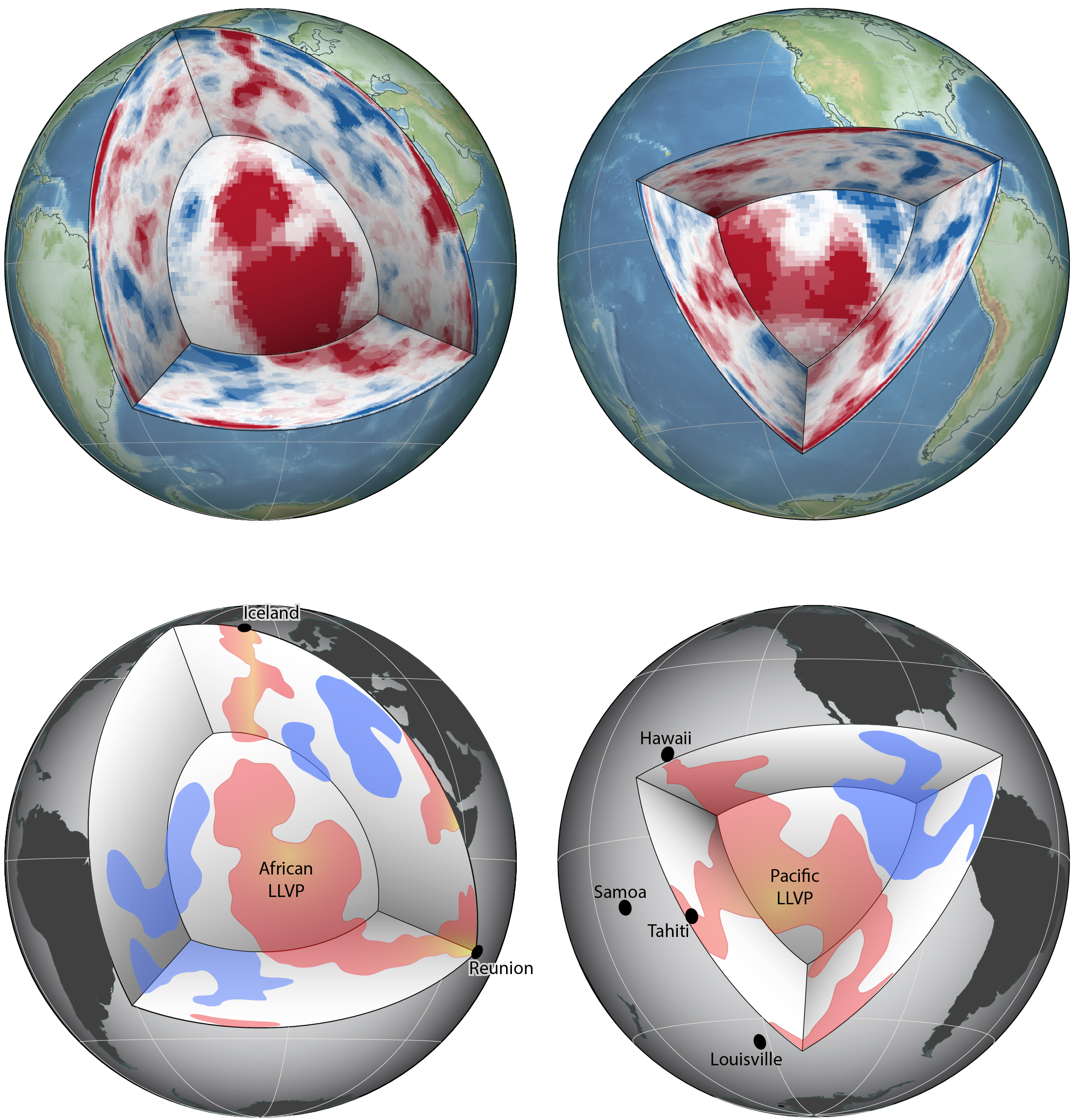
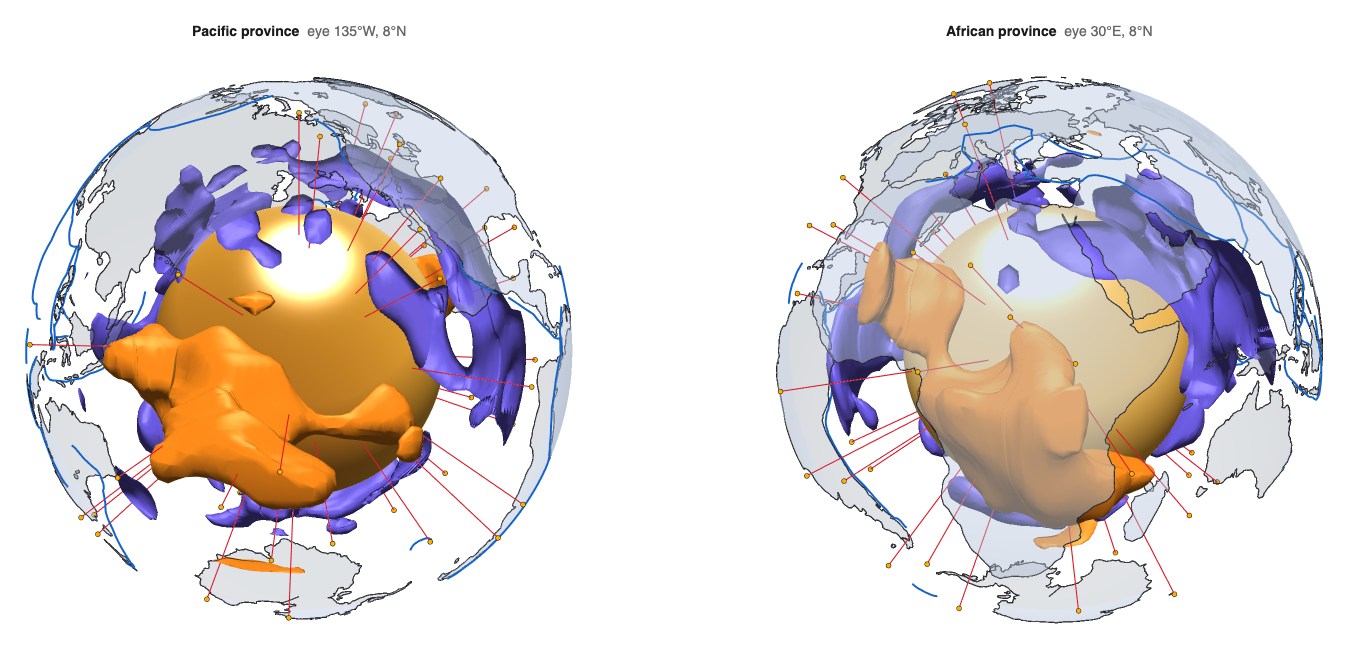
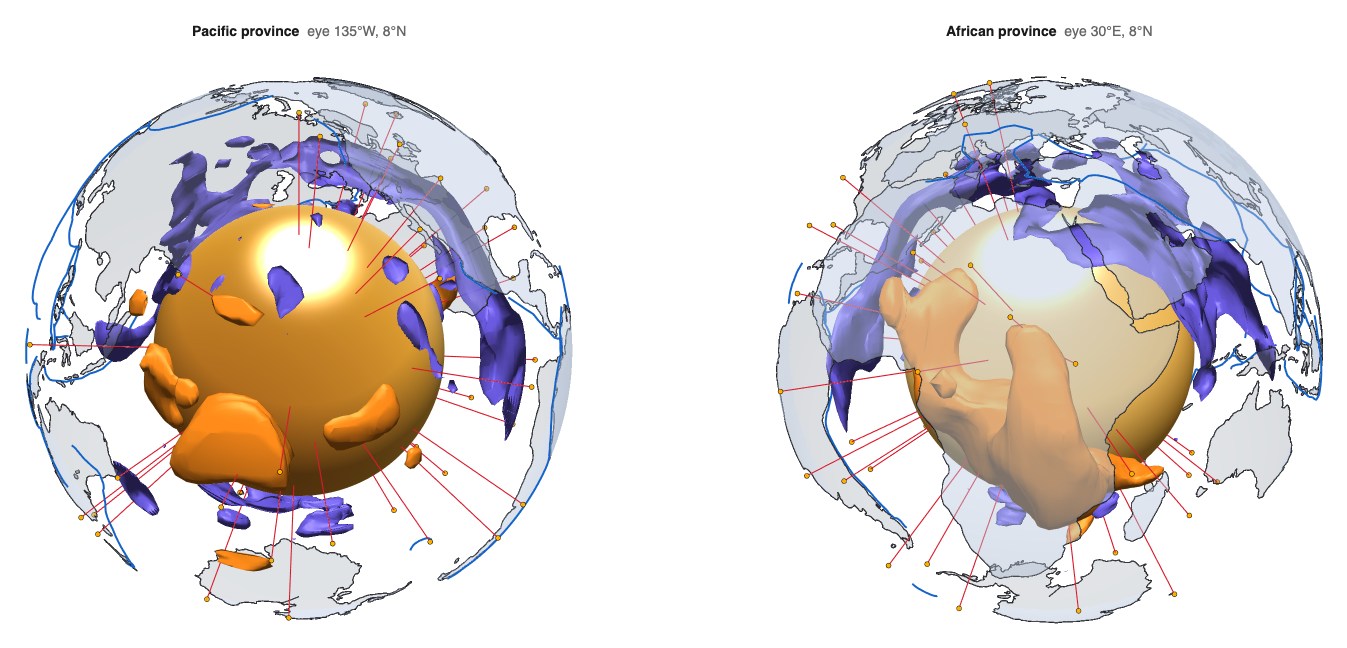
- Cutaway globes of the LLVPs — Cutaway views of the African and Pacific large low-velocity provinces at the base of the mantle.
- Model agreement (QAM) contours — Areas where all S- and P-wave models agree on the slowest and fastest cells, for consideration areas of 10–50%.
- Lateral gradients and LLVP edges — Strongest lateral VS gradients across nine models compared with smoothed LLVP outlines.
- LLVP outlines vs. gradient QAM — Smoothed model LLVPs (30% area) and the lateral-gradient QAM (20% area) across nine models.
- Forward modeling of LLVP edges — Forward-modeling tests of how sharp LLVP edges appear in tomographic images.
- LIPs, hotspots and kimberlites vs. LLVPs — Surface hotspots, large igneous provinces, and kimberlites compared with the LLVPs at the base of the mantle.
- Slab cross sections I — Tomographic VP and VS cross sections through subducted slabs: Tonga, Marianas, Japan, and Kamchatka.
- Slab cross sections II — Tomographic VP and VS cross sections through subducted slabs: Aleutians, Farallon, Peru, and Chile.
- Slab QAM cross sections — QAM cross sections showing model agreement on fast (slab) anomalies for eight subduction zones.
- Hotspot cross sections I — Tomographic cross sections through the mantle beneath major hotspots.
- Hotspot cross sections II — Further tomographic cross sections through the mantle beneath major hotspots.
- D″ discontinuity velocity profiles — Regional VS–depth profiles of D″ discontinuity models compared with PREM.
- D″ reflectors vs. QAMs — Reported D″ VP and VS discontinuities compared with tomographic QAMs.
- Post-perovskite in D″ — The bridgmanite to post-perovskite phase transition and its expression in the D″ region.
- Global radial anisotropy — Radial anisotropy in the deep mantle from global tomographic models.
- Radial anisotropy model agreement — Pairwise agreement between global radial-anisotropy models.
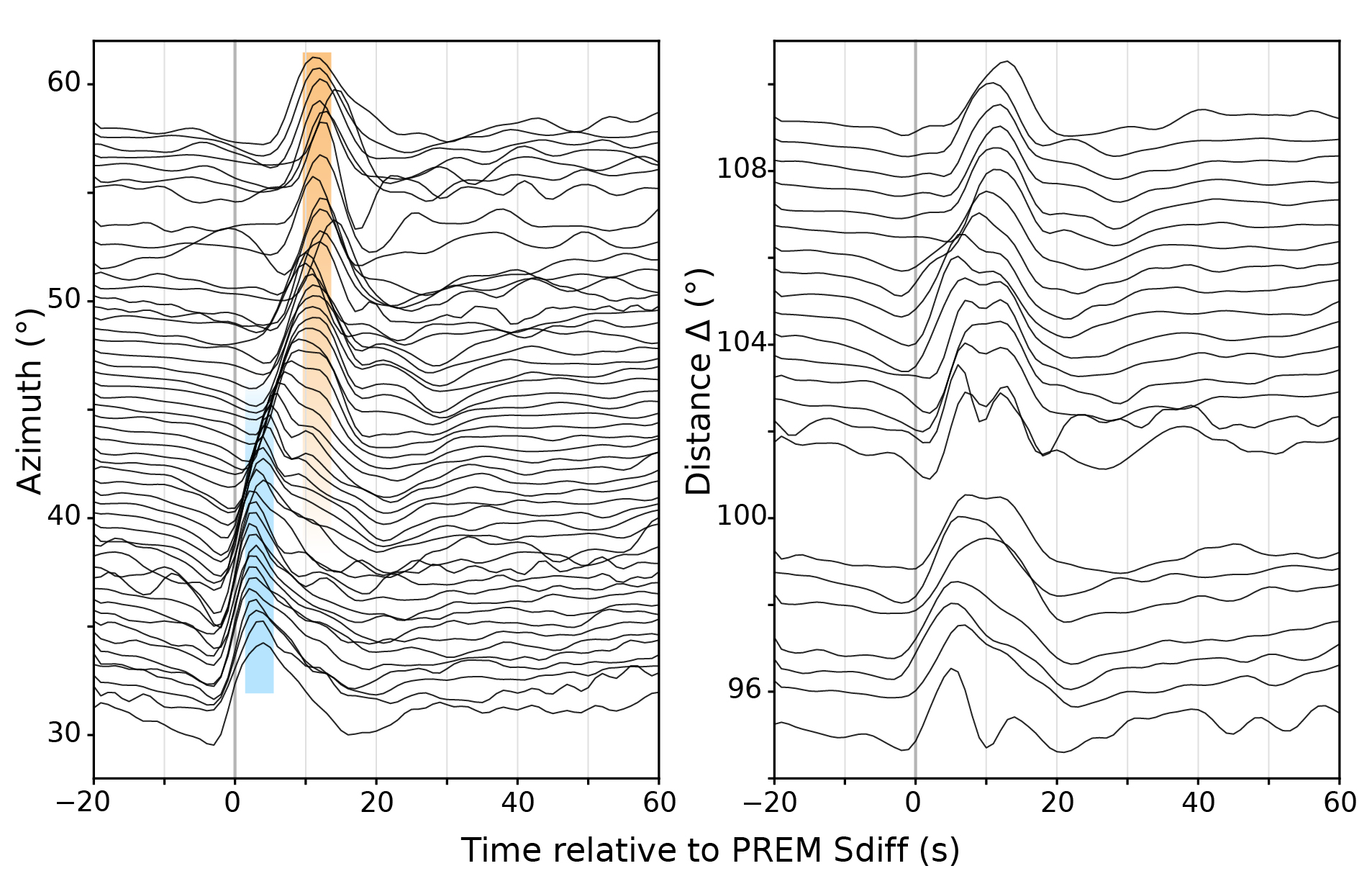
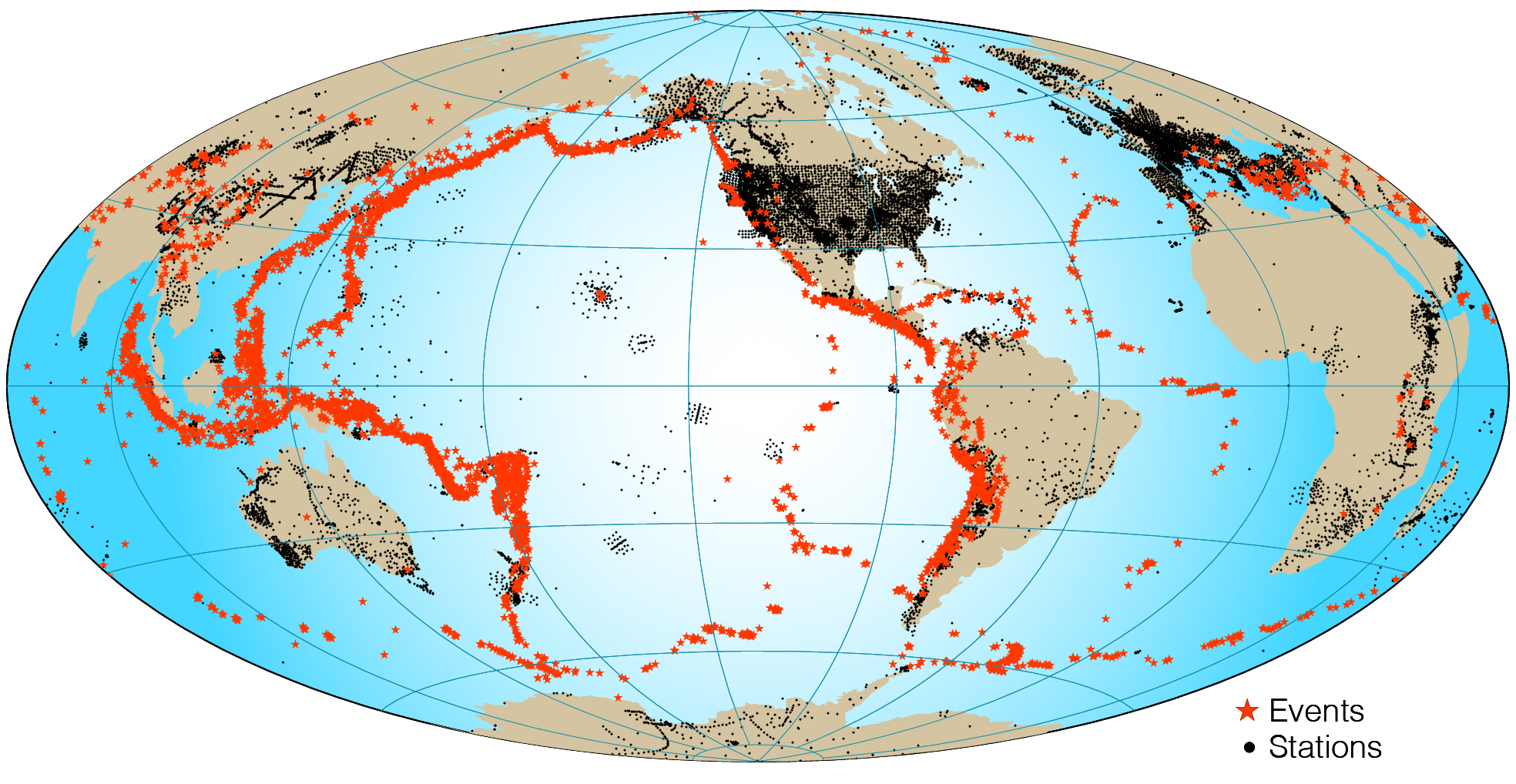
- Methods for measuring D″ anisotropy — Techniques used to detect D″ anisotropy — waveforms, ray geometries, and the global coverage of published studies.
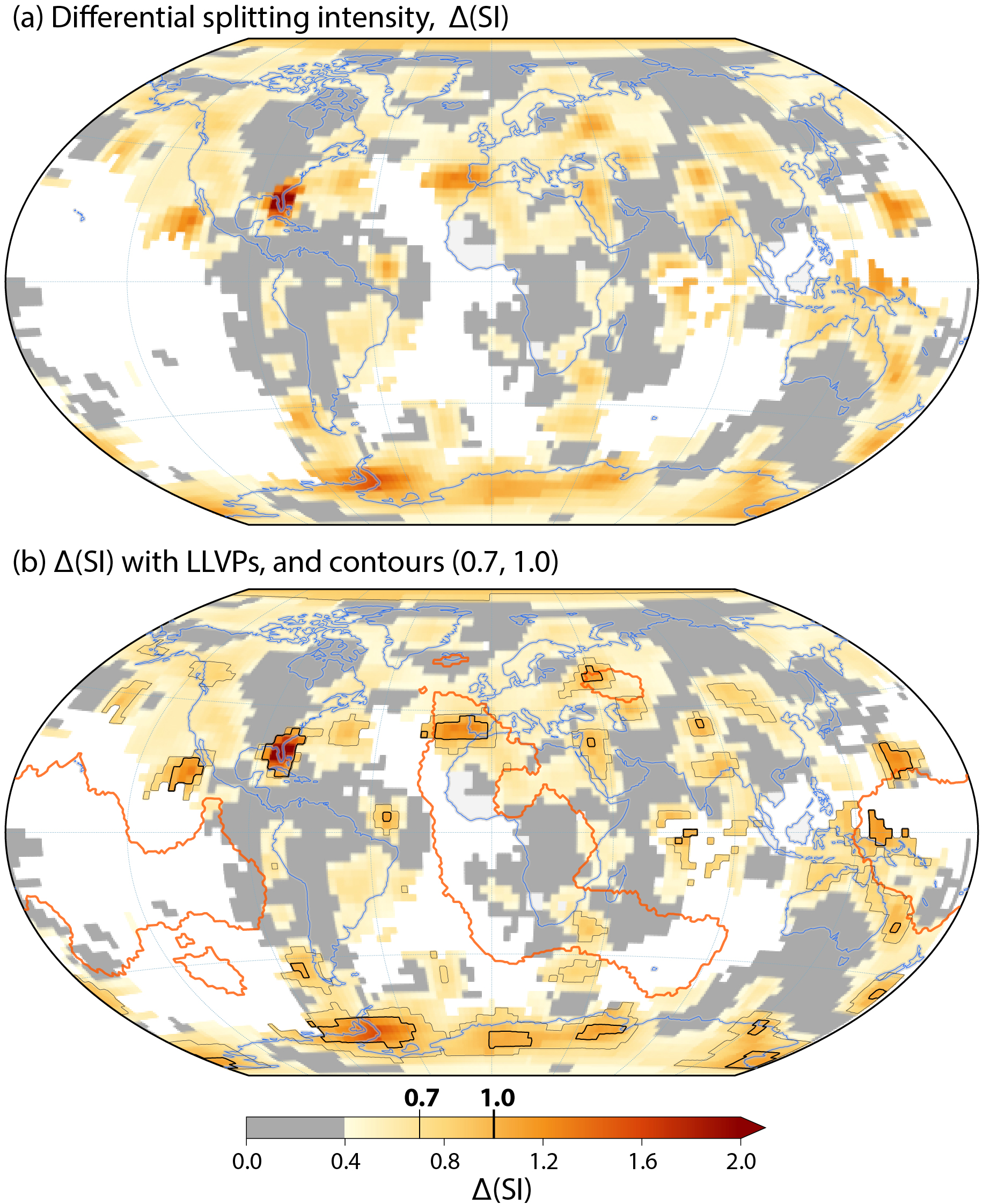
- Differential splitting intensity maps — Global differential splitting-intensity, Δ(SI), maps with LLVP outlines and contours.
- Scatterers vs. model agreement — Locations and heights of small-scale scatterers compared with S-wave model agreement at 2800 km.
- Seismic probes of ULVZs — Seismic phases used to probe ultralow-velocity zones at the core–mantle boundary.
- Global ULVZ detection map — ULVZ detections, uncertain detections, and sampled regions without ULVZs, with LLVP outlines and hotspots.
- ULVZ velocity reductions — Reported ULVZ P- and S-wave speed reductions, thicknesses, and density elevations across published studies.
Figures — Advances in mapping lowermost mantle convective flow with seismic anisotropy observations (Reviews of Geophysics, 2024)
- Shear-wave splitting in the lowermost mantle — A shear wave crossing anisotropic D″ splits into fast (blue) and slow (red) components. The delay time between them and the fast-polarization direction are the observables used to detect and characterize anisotropy at the base of the mantle.
- Seismic phases that sample D″ — Travel-time curves (PREM, 500 km source depth) for the body-wave phases — S, ScS, Sdiff, SKS, SKKS and their multiples — whose paths turn or reflect near the core–mantle boundary and are used to probe lowermost-mantle structure and anisotropy.
- Methods for measuring D″ anisotropy — Six complementary approaches — SV–SH travel times, phase polarities, *KS differential splitting, S–ScS differential splitting, regional anisotropic inversions, and Sdiff splitting — each shown with its ray geometry, global sampling, and representative waveforms.
- Global sampling of D″ by splitting measurements — Where each technique samples the lowermost mantle (azimuthal coverage, left) compared with the distribution of resolved seismic anisotropy relative to LLVP edges (right), for Sdiff, SKS–SKKS, S–ScS, and all methods combined.
- Depth and lateral distribution of anisotropy — (a) Radial-anisotropy profiles from global tomographic models highlight the strong signal at the top and base of the mantle; (b) map of where lowermost-mantle anisotropy has been detected, relative to the large low-velocity provinces (LLVPs).
- Comparison with geodynamic flow models — Predicted lateral (a) and radial (b) mantle-flow velocities from geodynamic models, the inferred flow geometry at sampled locations (c), and predicted flow directions across the base of the mantle (d), set against the anisotropy observations.
- Flow scenarios at the base of the mantle — Schematic end-member scenarios linking deep-mantle flow — such as slab-driven downwelling and plume-related upwelling — to the anisotropy that would be observed, used to interpret measurements in terms of mantle convection.
Contact
Jonathan Wolf, Department of Earth and Planetary Sciences, University of California, Santa Cruz, 1156 High Street, Santa Cruz, CA 95064. Email: wolf@ucsc.edu